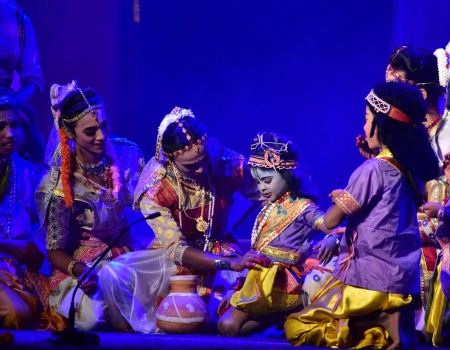
Raas Mahotsav or festival is the story of the life of Lord Krishna presented in the performing art form. It begins with the birth of Krishna, his upbringing at the house of Nanda, his tending the cows at Gokula along with his fellow cowherds, his childhood activities, his killing of the demons like Bakasur, Oghasur, Pralambasur, Dhenukasur, Chakrabar, Putana, Kaliya and Kamsha - his maternal uncle - at various times of his youth and on various other occasions and finally his amorous play with the Gopis.
Raas Mahotsav is an annual festival performed on the fool moon day in the month of November during the Autumn season. Raas Leela was initially performed at Dakhinpat Satra in 1840 AD and it has sustained its rituals and traditions.
History of Raas Festival
Assam’s first Raas Festival and act began at Sri Sri Dakhinpat Satra. With complete vedic rituals, traditions and acts, this Raas Festival is one of the oldest in Assam.
According to folklore, Dakhinpat Satra’s 10th Satradhikar Basudev Goswami got a devine order in his dreams to hold Shri Krishna Raas Leela in the Satra in order to save the Satra from erosion. Following that order Basudev Goswami wrote a play on Shri Krishna’s life till the killing of Aristasur and began holding acts based on that play.
The most striking characteristic of Raas festivities of Dakhinpat Satra is that during the performance, as each of the character enters the stage, there is a facility to worship the idols of each of the characters. And as Balram Krishna and their fellow cowherds enter the stage, all the musical instruments are played together and Satradhikar and the audience members stand up and pray the Gods.
On the third day is Indrabhishek Puja and Indrabhishek dance programme. By the evening, the idol of “Brindavan Chandra” is broght down from the stage and after taking around the Satra, it is placed back in the Monikut. Raas Leela was introduced as a stage performance by Pitambar Dev Goswami, ex-Satradhikar and social reformer of Garamur Satra in the year 1934.
In 1950, he permitted the girls of the Satra to take roles in the Raas Leela and dance. Today, in most of the centers, women participation in Raas Leela performance is quite normal. This festival has a great impact on the life and culture of the people of Majuli. Though it is a part of the culture of the Satras, it is performed in many of the villages.
During the festival, every man, woman and child remains busy receiving visitors and performing different duties related to the festival. It is reported that during the festival that lasts for three to four days at a stretch, thousands of outsiders visit the island, and almost every family of Majuli treats them as their guest and provide them accommodation at their homes.

